Homegrown
Build robots with parts made in America
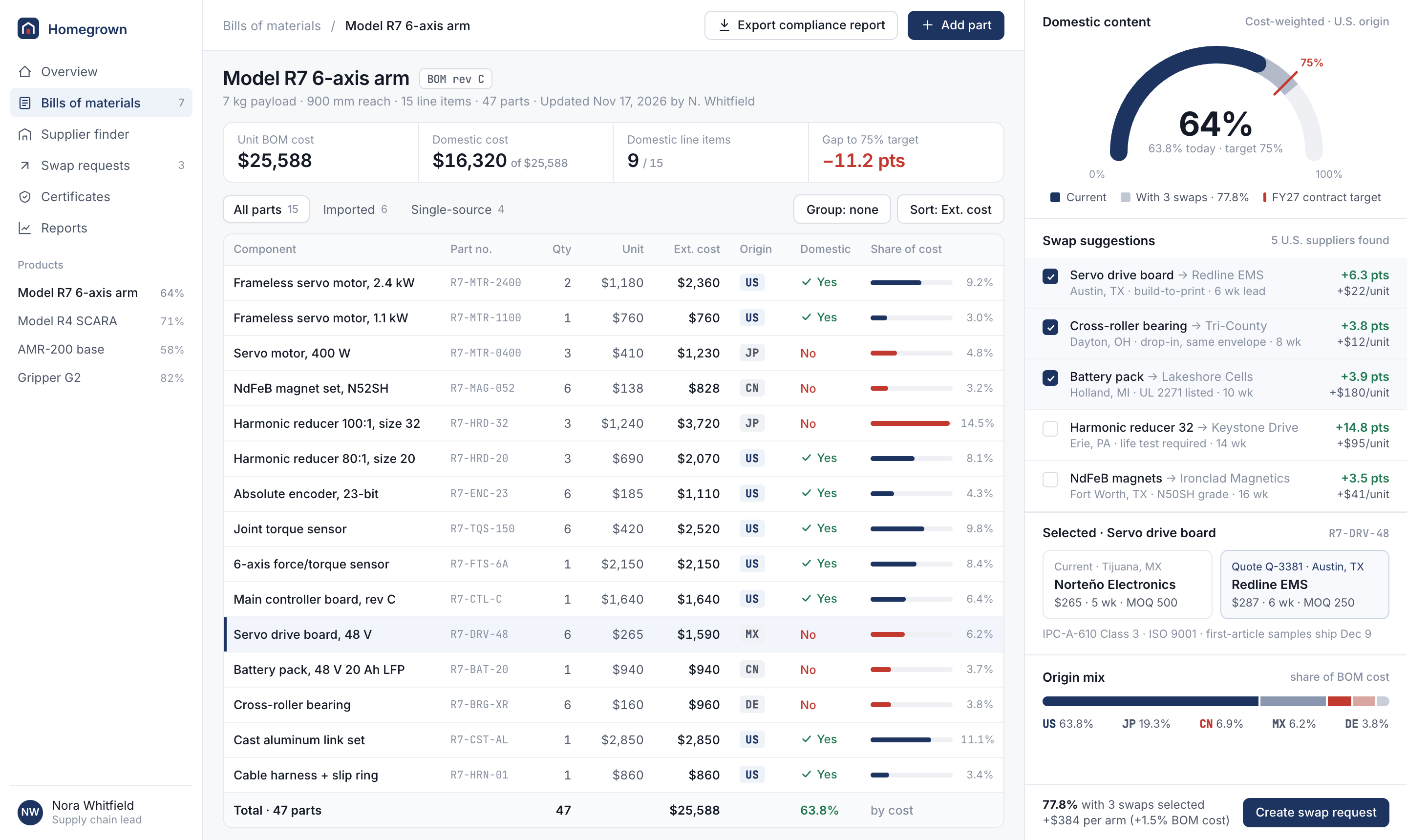
A bill-of-materials builder for robots that scores domestic content as you design. See which motors, magnets, gears and boards come from where, what it costs to move each one to a U.S. supplier, and how far you are from the target.
Who uses it: Robotics hardware teams and their sourcing leads.
Screens
Components with quantity, cost, country of origin and domestic flag.
Score against the target, by cost share, with what moves it most.
U.S. suppliers for a part with cost and lead-time delta.
Domestic supplier directory by component type.
BOM versions with score history.
How it runs
Data model
- productsid, name, target_domestic_pct
- bom_versionsid, product_id, version, created_at
- componentsid, bom_version_id, kind (motor | magnet | gear | encoder | sensor | board | battery), part_no, qty, unit_cost_cents, origin_country, supplier_id
- suppliersid, name, country, kinds[], lead_weeks
- swap_optionsid, component_id, supplier_id, unit_cost_cents, lead_weeks
API
- GET/api/products/{id}/bomCurrent BOM with domestic score
- POST/api/products/{id}/bom/importImport a BOM (CSV)
- PATCH/api/components/{id}Edit a component
- GET/api/components/{id}/swapsDomestic swap options
- POST/api/components/{id}/swapApply a swap (new BOM version)
- GET/api/products/{id}/score-historyScore per version
Build it with your agent
Copy the prompt into Claude Code, Codex, Cursor or any coding agent connected to Nexlayer. It works from a spec: contracts first, then each phase with checks that must pass, then it ships to Nexlayer and verifies the live app.
- 1Spec + contract→
- 2API→
- 3Web→
- 4End-to-end test→
- 5Ship + verify
Build Homegrown: build robots with parts made in America. A production full-stack web application, deployed live on Nexlayer.

Work spec-first. Before writing app code, write SPEC.md (from the spec below, plus your decisions), api/openapi.yaml and the first migration, and show me a short plan. Then build in phases and don't move on until each phase's checks pass.

## Product
A bill-of-materials builder for robots that scores domestic content as you design. See which motors, magnets, gears and boards come from where, what it costs to move each one to a U.S. supplier, and how far you are from the target.
Users: Robotics hardware teams and their sourcing leads.

## Screens
- BOM: Components with quantity, cost, country of origin and domestic flag.
- Domestic content: Score against the target, by cost share, with what moves it most.
- Swaps: U.S. suppliers for a part with cost and lead-time delta.
- Suppliers: Domestic supplier directory by component type.
- Versions: BOM versions with score history.

## Data model (Postgres)
- products(id, name, target_domestic_pct)
- bom_versions(id, product_id, version, created_at)
- components(id, bom_version_id, kind (motor | magnet | gear | encoder | sensor | board | battery), part_no, qty, unit_cost_cents, origin_country, supplier_id)
- suppliers(id, name, country, kinds[], lead_weeks)
- swap_options(id, component_id, supplier_id, unit_cost_cents, lead_weeks)

## API
- GET /api/products/{id}/bom — Current BOM with domestic score
- POST /api/products/{id}/bom/import — Import a BOM (CSV)
- PATCH /api/components/{id} — Edit a component
- GET /api/components/{id}/swaps — Domestic swap options
- POST /api/components/{id}/swap — Apply a swap (new BOM version)
- GET /api/products/{id}/score-history — Score per version

## Seed data
One 6-axis robot arm with 22 components, 30 suppliers (half U.S.), swap options for the 8 most expensive parts.

## Core flow (must work end to end)
Import a BOM, see the domestic score, apply a swap for the motors, and see the score and cost change in a new version.

## Stack (fixed)
- web/: React 19 + TypeScript (strict) + Vite, React Router, TanStack Query, Tailwind CSS. A typed API client generated from the OpenAPI spec. Served as static files by a small web server in its own container.
- api/: Go (latest stable), net/http with Go 1.22+ routing patterns or chi, pgx v5, sqlc for queries, golang-migrate for migrations, log/slog JSON logs, OpenAPI 3.1 spec in api/openapi.yaml as the contract.
- Postgres 16, on a persistent volume.

## Engineering bar
- Contract first: api/openapi.yaml is the source of truth; the Go handlers and the web client are generated from or checked against it.
- Errors as RFC 9457 problem+json. Validate every input at the edge. Cursor pagination on every list.
- Auth: email magic link or password with argon2id; HTTP-only, SameSite session cookies; role checks in the API, never only in the UI.
- Idempotency keys on every POST that creates or submits something. Request timeouts via context. Graceful shutdown.
- GET /api/healthz (process up) and GET /api/readyz (database reachable, migrations applied).
- Migrations run on start, forward only. Seed data behind a SEED=true flag.
- Web: loading, empty and error states on every screen; keyboard accessible; no layout shift.
- Tests: Go table-driven tests, integration tests against a real Postgres (testcontainers), and one Playwright test for the core flow. Lint and typecheck clean.

## Phases
1. Contract: SPEC.md, openapi.yaml, schema and migrations, seed data. Check: migrations apply cleanly to an empty database.
2. API: every endpoint in the spec, with auth and role checks. Check: Go tests and integration tests pass.
3. Web: every screen, wired to the API through the generated client. Check: typecheck and lint pass; every screen has loading, empty and error states.
4. End to end: the Playwright test for the core flow passes locally.
5. Ship on Nexlayer (below).

## Ship it on Nexlayer
- Load the Nexlayer skill first: call nexlayer_get_skill_content with skillName "ship-it-nexlayer" and follow it.
- Dockerfiles: multi-stage, small runtime images, built for linux/amd64.
- nexlayer.yaml: three parts. web with path "/", api with path "/api", postgres with no path (private) and a volume. Set PGDATA to a subdirectory of the volume mount. The api reaches the database at postgres.pod; the browser reaches the api at <% URL %>/api. Secrets are ${NAME} references, never values.
- Deploy with `nexlayer ship --check /api/readyz` if the Nexlayer CLI is installed, otherwise through the Nexlayer MCP (validate, deploy, check status).
- Don't stop at "deployed": open the live URL, run the core flow against it, and send me the URL with what you verified.
New to Nexlayer? Connect your agent first