Inkwell
Teach a model to write like a person
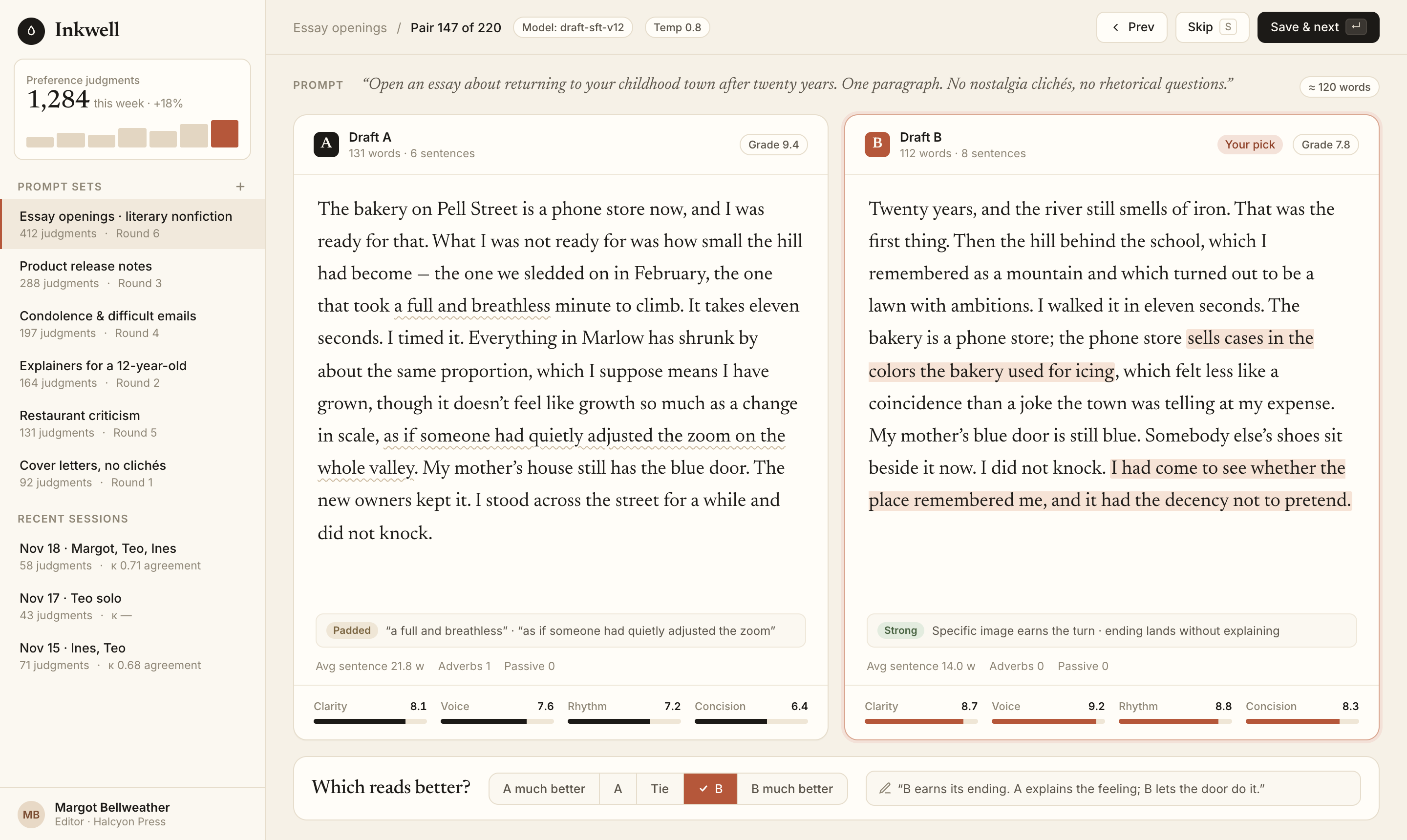
A writing studio for collecting the data that makes models write well. Writers compare drafts side by side, pick the better one and say why, and score voice, clarity and rhythm. Every judgment becomes preference data you can export for training.
Who uses it: Writers and editors who judge drafts, and the research team that trains on their judgments.
Screens
Two drafts of the same prompt side by side, pick the better one, give a reason.
Rate a draft on clarity, voice, rhythm and concision.
Writing prompts by genre, with how many judgments each has.
Agreement between raters and each rater's calibration.
Preference pairs as JSONL with filters (genre, agreement, date).
How it runs
Data model
- usersid, email, name, role (rater | researcher | admin)
- promptsid, genre, body, created_at
- draftsid, prompt_id, model, body, created_at
- comparisonsid, prompt_id, draft_a, draft_b, winner, reason, rater_id, at
- scoresid, draft_id, rater_id, clarity, voice, rhythm, concision
- exportsid, filters jsonb, row_count, storage_key, created_by, created_at
API
- GET/api/tasks/nextNext comparison for this rater (balanced across prompts)
- POST/api/comparisonsRecord a judgment
- POST/api/scoresRecord scores
- POST/api/prompts/{id}/draftsGenerate drafts from the model (SSE)
- GET/api/stats/agreementInter-rater agreement
- POST/api/exportsBuild a JSONL export
- GET/api/exports/{id}/downloadDownload it
Build it with your agent
Copy the prompt into Claude Code, Codex, Cursor or any coding agent connected to Nexlayer. It works from a spec: contracts first, then each phase with checks that must pass, then it ships to Nexlayer and verifies the live app.
- 1Spec + contract→
- 2API→
- 3Web→
- 4AI→
- 5End-to-end test→
- 6Ship + verify
Build Inkwell: teach a model to write like a person. A production full-stack web application, deployed live on Nexlayer.

Work spec-first. Before writing app code, write SPEC.md (from the spec below, plus your decisions), api/openapi.yaml and the first migration, and show me a short plan. Then build in phases and don't move on until each phase's checks pass.

## Product
A writing studio for collecting the data that makes models write well. Writers compare drafts side by side, pick the better one and say why, and score voice, clarity and rhythm. Every judgment becomes preference data you can export for training.
Users: Writers and editors who judge drafts, and the research team that trains on their judgments.

## Screens
- Compare: Two drafts of the same prompt side by side, pick the better one, give a reason.
- Score: Rate a draft on clarity, voice, rhythm and concision.
- Prompts: Writing prompts by genre, with how many judgments each has.
- Raters: Agreement between raters and each rater's calibration.
- Export: Preference pairs as JSONL with filters (genre, agreement, date).

## Data model (Postgres + pgvector)
- users(id, email, name, role (rater | researcher | admin))
- prompts(id, genre, body, created_at)
- drafts(id, prompt_id, model, body, created_at)
- comparisons(id, prompt_id, draft_a, draft_b, winner, reason, rater_id, at)
- scores(id, draft_id, rater_id, clarity, voice, rhythm, concision)
- exports(id, filters jsonb, row_count, storage_key, created_by, created_at)

## API
- GET /api/tasks/next — Next comparison for this rater (balanced across prompts)
- POST /api/comparisons — Record a judgment
- POST /api/scores — Record scores
- POST /api/prompts/{id}/drafts — Generate drafts from the model (SSE)
- GET /api/stats/agreement — Inter-rater agreement
- POST /api/exports — Build a JSONL export
- GET /api/exports/{id}/download — Download it

## AI
- Generate competing drafts for a prompt from the model at different settings, streamed into the compare view.
- Embed drafts in pgvector to avoid near-duplicate pairs.

## Seed data
40 prompts across 5 genres, 2 drafts each, 3 raters with 200 prior judgments so agreement charts have data.

## Core flow (must work end to end)
A rater gets a comparison, picks a winner with a reason, scores both drafts, and a researcher exports the judgment as JSONL.

## Stack (fixed)
- web/: React 19 + TypeScript (strict) + Vite, React Router, TanStack Query, Tailwind CSS. A typed API client generated from the OpenAPI spec. Served as static files by a small web server in its own container.
- api/: Go (latest stable), net/http with Go 1.22+ routing patterns or chi, pgx v5, sqlc for queries, golang-migrate for migrations, log/slog JSON logs, OpenAPI 3.1 spec in api/openapi.yaml as the contract.
- Postgres 16 with the pgvector extension (HNSW indexes on embedding columns), on a persistent volume.
- AI: Nexlayer Inference. Read the endpoint, model and key from environment variables NEXLAYER_INFERENCE_URL, NEXLAYER_INFERENCE_MODEL and NEXLAYER_INFERENCE_API_KEY. The key comes from https://inference.nexlayer.com/app/#/models: ask me to add it as a secret in Nexlayer. Never ask me to paste it into this chat and never write it into the repo.

## Engineering bar
- Contract first: api/openapi.yaml is the source of truth; the Go handlers and the web client are generated from or checked against it.
- Errors as RFC 9457 problem+json. Validate every input at the edge. Cursor pagination on every list.
- Auth: email magic link or password with argon2id; HTTP-only, SameSite session cookies; role checks in the API, never only in the UI.
- Idempotency keys on every POST that creates or submits something. Request timeouts via context. Graceful shutdown.
- GET /api/healthz (process up) and GET /api/readyz (database reachable, migrations applied).
- Migrations run on start, forward only. Seed data behind a SEED=true flag.
- AI calls: timeouts, retries with backoff, streamed responses over SSE, prompts kept in files, structured JSON output validated before use, and a clear UI state when NEXLAYER_INFERENCE_API_KEY is missing (the rest of the app still works).
- Web: loading, empty and error states on every screen; keyboard accessible; no layout shift.
- Tests: Go table-driven tests, integration tests against a real Postgres (testcontainers), and one Playwright test for the core flow. Lint and typecheck clean.

## Phases
1. Contract: SPEC.md, openapi.yaml, schema and migrations, seed data. Check: migrations apply cleanly to an empty database.
2. API: every endpoint in the spec, with auth and role checks. Check: Go tests and integration tests pass.
3. Web: every screen, wired to the API through the generated client. Check: typecheck and lint pass; every screen has loading, empty and error states.
4. AI: retrieval, model calls and streaming as described. Check: works with a key, degrades clearly without one.
5. End to end: the Playwright test for the core flow passes locally.
6. Ship on Nexlayer (below).

## Ship it on Nexlayer
- Load the Nexlayer skill first: call nexlayer_get_skill_content with skillName "ship-it-nexlayer" and follow it.
- Dockerfiles: multi-stage, small runtime images, built for linux/amd64.
- nexlayer.yaml: three parts. web with path "/", api with path "/api", postgres with no path (private) and a volume. Set PGDATA to a subdirectory of the volume mount. The api reaches the database at postgres.pod; the browser reaches the api at <% URL %>/api. Secrets are ${NAME} references, never values.
- Deploy with `nexlayer ship --check /api/readyz` if the Nexlayer CLI is installed, otherwise through the Nexlayer MCP (validate, deploy, check status).
- Don't stop at "deployed": open the live URL, run the core flow against it, and send me the URL with what you verified.
New to Nexlayer? Connect your agent first